












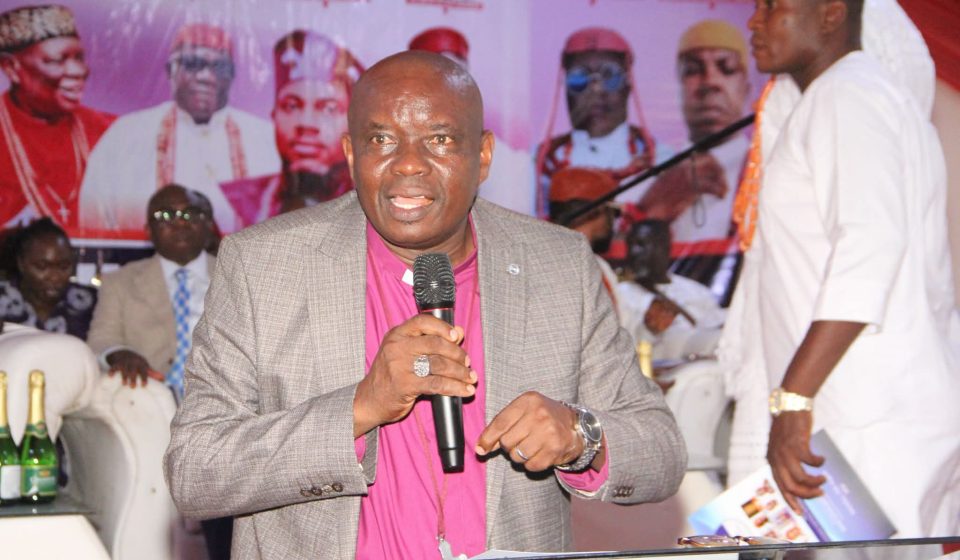

The Bishop of Ika Anglican Diocese, Rt. Rev. Godfrey Ifeanyichukwu Ekpenisi, has unveiled an ambitious seven-year development blueprint, “Ika Vision 2032: A Church Revived; A People Transformed,” aimed at strengthening the Church and accelerating the social and economic transformation of Ika Nation.
The vision was presented on recently during the 26th Ogwa Ika held in Ika Nation, with the theme: “Building a Strong Church and a Mighty Ika Nation.”
According to Bishop Ekpenisi, the vision seeks to build a vibrant, doctrinally sound, mission-driven, and socially responsible Church while promoting an Ika Nation that is morally awakened, economically productive, educationally advanced, and spiritually grounded.
He explained that the initiative was anchored on two broad objectives: “A Strong Church” that is spiritually and economically empowered and “A Mighty Ika Nation” that is morally awakened and positioned for sustainable development.
Reflecting on the journey from 2018 to 2025, the Bishop said the Diocese had recorded significant achievements through God’s grace, particularly in spiritual growth, infrastructure development, and people-centered programmes.
He noted that parish life had been revitalized, while evangelism, youth conferences, and mission drives had expanded across 101 churches in 11 Ika clans and Igbanke.
On infrastructure, he listed the rehabilitation of Ika Grammar School, Boji-Boji Owa; El-Pohar Hospital and Diagnostic Centre; Boclesia Apartments; Water Factory; Park and Garden; Diamond Mothers’ Kitchen; Ika Queens Grammar School; and Ika Prince and Princess Nursery/Primary School, alongside the construction and reconstruction of several church buildings.
The Bishop also highlighted the impact of the Diocesan Charity Foundation, which, he said, had provided food, scholarships, and grants to indigent Anglican and non-Anglican families.
He further cited the activities of the Ika Youth Empowerment and Development Centre (IYEDC), which has focused on mentorship, digital literacy, and coding, as well as the Ika Youth Arise Initiative, which reached more than 2,000 youths in 2024/2025.
Bishop Ekpenisi said the achievements had laid the foundation for a more comprehensive development agenda, stressing that the hunger for God, the needs of young people, and the challenges confronting communities now demanded greater intentionality.
The Bishop said Ika Vision 2032, covering January 2026 to December 2032, would be implemented through five strategic pillars designed to develop people, strengthen institutions, and stimulate sustainable economic growth.
The first pillar, Agro-Industrial Development, is focused on building stronger synergy among farmers and creating effective communication and value chains from the farm to the factory.
He observed that a significant proportion of agricultural produce from Ika Land currently leaves the area in raw form, thereby depriving local communities of substantial economic opportunities.
Under the initiative, attention will be given to cassava, oil palm, maize, plantain, bananas, yams, and vegetables, with plans for processing clusters in Agbor, Owa, Umunede, Mbiri, Igbanke, and other communities.
The proposed Ika Agro-Industrial Park and Ika Agro Connect digital platform are expected to support the initiative, with a target of creating 5,000 direct and 15,000 indirect jobs within five years.
The second pillar, Education and Skill Acquisition, is driven by the philosophy: “Educating the Head, Training the Hand, Touching the Heart.”
The vision seeks to ensure that no Ika child is left behind and no talent is wasted through scholarships, bursaries, peace and integrity programmes, Bible clubs, school visits, and youth engagements.
A major flagship project under this pillar is a 480-capacity dual-curriculum boarding comprehensive college with technical studies, combining the Nigerian and British curricula, with the ultimate goal of producing globally competitive graduates who will return to contribute to the development of Ika Nation.
The third pillar, Strategic Security and Peace Building, will focus on community security, peacebuilding initiatives, the establishment of a Security Trust Fund, and stronger synergy between security structures and social development programmes.
The fourth pillar, Community Engagement and Social Renewal, will promote town hall meetings and sustained engagement with youths, community leaders, and traditional rulers.
According to the Bishop, the programme will address issues including drug abuse, youth-related negative vices, school counselling, marriage seminars, health outreaches, leadership and business summits, as well as rehabilitation and support for victims.
The fifth pillar, Critical Infrastructure and Industrial Development, includes the development of major educational and agro-industrial projects.
Among the proposed projects are the 480-capacity Anglican International College, Agbor; Anglican Comprehensive College and Skill Centre, Owa-Alizomor; and agro-processing mills at Abavo, Owanta, and Igbanke.
To actualize the vision, Bishop Ekpenisi disclosed that the Diocese intends to raise N3 billion over seven years for project execution.
He announced that the formal launch of the initiative would take place at Vienna Arena, Boji-Boji Owa, on Saturday, September 12, 2026, at 1:00 p.m.
He stressed that the vision would be backed by a structured governance and accountability framework, including a Fund Management Board, annual evaluation, independent auditing, transparent financial reporting, and regular public updates.
The Bishop also emphasized the need for continuity structures capable of ensuring that projects and programmes outlive individual personalities and administrations.
Bishop Ekpenisi described Ika Vision 2032 as a collective project that transcends any individual, organization, or generation.
He called on individuals, institutions, traditional rulers, community leaders, businesses, professionals, and other stakeholders to partner with the initiative, noting that such support would amount to an investment in the future of Ika Nation.
According to him, supporting the vision would help build future leaders, rescue youths from destructive paths, empower families, strengthen communities, expand God’s Kingdom, and promote generational transformation.
Concluding his presentation, the Bishop recalled the mandate embraced seven years ago and expressed gratitude to God for the progress recorded so far.
He said the greater task ahead would require sacrifice, accountability, unity, and faith, stressing that the objective was not merely to consolidate past achievements but to institutionalize sustainable transformation across Ika Nation.
He prayed that the vision would unite the people, inspire the mission, and produce achievements that would outlive the present generation, giving all glory to God.
By Patrick Gbuchanye
